
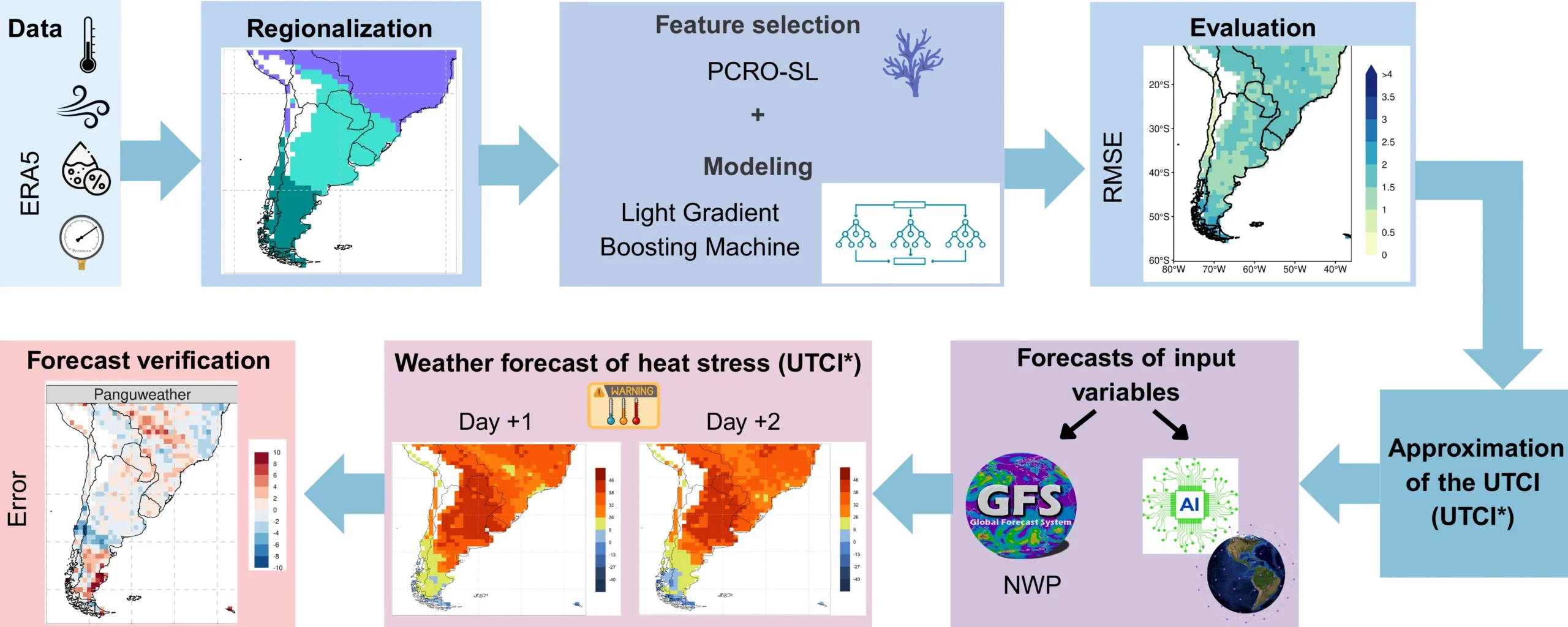
Heat stress is a growing concern for public human health systems, underscoring the need for reliable thermal stress forecasting tools. This study introduces a novel approach to estimating the Universal Thermal Climate Index (UTCI) for southern South America using a reduced subset of variables from data-driven weather forecast models. These data-driven models offer rapid, accurate, and publicly accessible forecasts of meteorological variables. However, they do not provide all the variables required to calculate the UTCI. To address this limitation, this study provides a method to estimate heat stress in southern South America using advanced feature selection techniques and regression/classification models. We apply a wrapper evolutionary approach based on the Probabilistic Coral-Reef Optimization with Substrate Layers algorithm (PCRO-SL), previously tested in complex optimization problems, to identify key meteorological variables at both individual grid points and within homogeneous UTCI regions defined through K-means clustering. Various regression and classification models are then constructed and evaluated against reanalysis ground-truth UTCI data. The combination of PCRO-SL and Light Gradient Boosting Machine emerges as the most effective approach. The method is successfully implemented to estimate UTCI during three heat waves using forecasts from data-driven models. The results demonstrate a good predictive skill for forecasts up to three days in advance, outperforming a traditional numerical weather prediction model. This research represents a significant advance towards the development of a thermal stress early warning system for the region, potentially enhancing public health interventions through timely preventive measures against extreme thermal conditions.
Collazo, S., Pérez-Aracil, J., Marina, C.M. et al. Toward Operational Heat-Stress Early Warnings in Southern South America: AI-Based UTCI Forecasting. Earth Syst Environ (2026). https://doi.org/10.1007/s41748-026-01194-4